
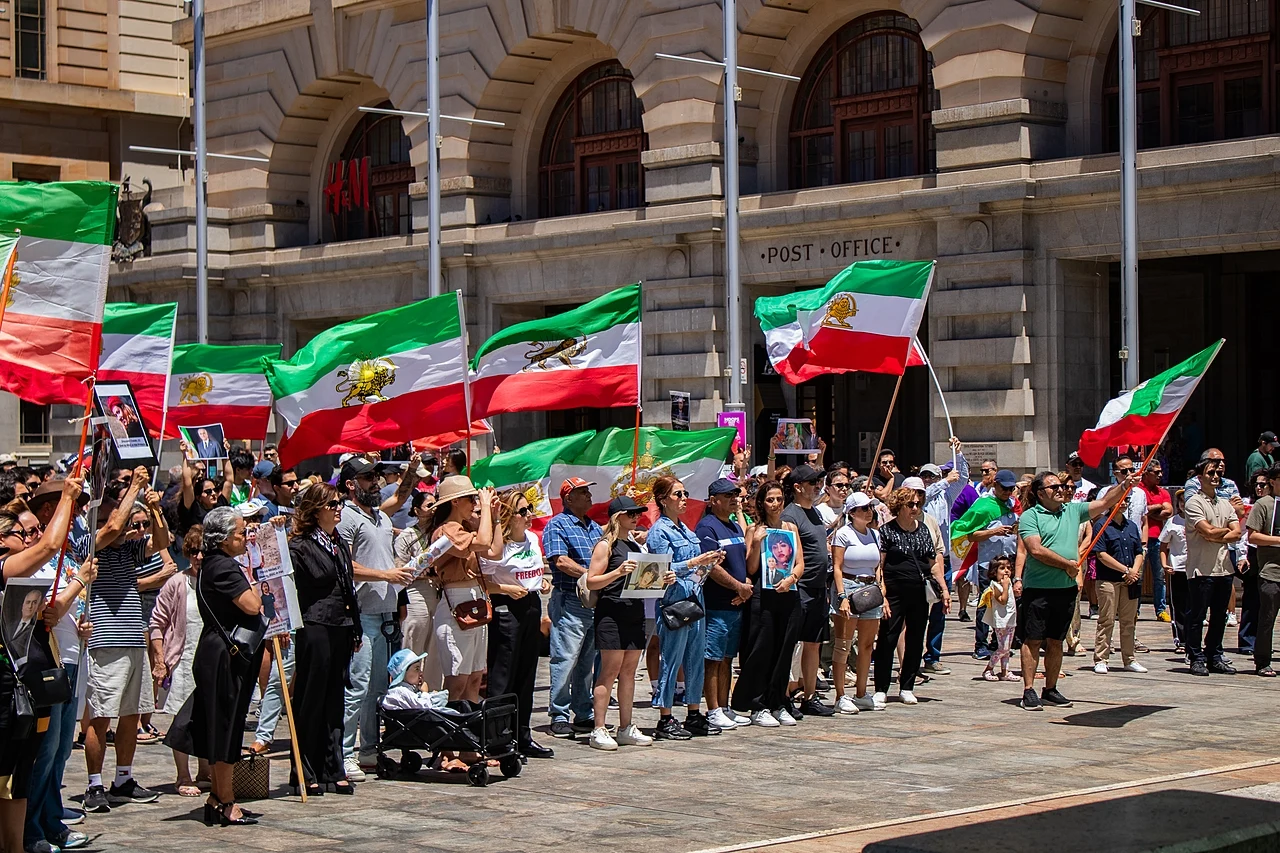
Iran is experiencing some of the largest protests in the nation’s history since the 1979 Islamic Revolution, ignited by rises in the cost of essential goods, corruption, and economic malaise. Beginning on 28 December 2025, it is thought that 500 people have already been killed and over 10,000 arrested, with many protestors openly calling for the end of the Iranian regime. The sharp decline in value of Iranian currency and economic stagnation exacerbated by US sanctions have contributed to the mass demonstrations which pose a serious challenge to the regime’s survival.
Notably, many among the protestors are waving the flag of the Imperial State of Iran and are chanting slogans in support of the Iranian former Shah, Mohammad Reza Pahlavi. The Shah was the Monarch of Iran until his overthrow in the Islamic Revolution of 1979. His rule was characterised by secularism and greater political and cultural alignment with the United States, but was also resented by much of the population for its repressive character and perceived complicity in “Imperialism” by Western countries in the region.
The Shah’s son, Reza Pahlavi, lives in exile in the United States and has spent much of his life calling for the overthrow of the current regime. On January 8th, Pahlavi further ignited the fervour of protestors with a call for unified protests against the regime. In the past, he has advocated for liberal democracy and constitutional monarchy in Iran, and for its future to be decided by referendum. He has also expressed support for mending relations and allying with the United States and Israel. Many believe he could play a critical role in Iran’s future if the regime collapses.
However, not all protestors are excited by the prospect of a return to monarchy in Iran. Demonstrators and supporters of the National Council of Resistance of Iran (NCRI) have chanted slogans of “Death to the oppressor, whether Shah or Rahbar”, and “No Mullahs, No Shah”. The NCRI is an exiled coalition of secularist, anti-regime and anti-monarchist groups, whose supporters have claimed that fake voice-overs, AI-manipulated videos and bot networks are being used to generate support for a return to monarchism. While all protestors are clear that they want political change, they do not all want to see the same politicians replace the regime.
Without any real democratic channels, the fragmentation of the Iranian regime could result in Iran entering a dangerous political vacuum as states like Syria did in the Arab Spring of 2011. Iran is home to a diverse range of ethnic groups, and many among them have historic grievances against the regime. There are thought to be between 7 and 15 million Kurds in Iran, primarily concentrated in the country’s Northwest, and the government has repeatedly used violent repression against Kurdish activists. Iran has a long history of clashes with Kurdish separatist militias, and while Iranian Kurds have been wary of fully joining the recent protests so far, figures within the Kurdish political movement warn that this restraint may not hold and protests may quickly spread across Kurdish cities.
The protests have not gone unnoticed by the international community. Most notably, US President Donald Trump has stated that Iranian authorities would be “hit very hard” if more protestors are killed. Reza Pahlavi has called for Trump to support the protests, while Iranian authorities have threatened retaliatory strikes against Israel and US military bases if he attempts to intervene. The US has a number of active military bases in neighbouring Iraq, and they have previously come under attack from Iranian forces in the form of ballistic missile strikes, such as in 2020 when the Islamic Revolutionary Guard Corps targeted Al-Asad Airbase in retaliation for the assassination of General Qasem Soleimani.
There remains a real possibility that Trump may continue his recent streak of hawkish foreign policy moves and intervene in the conflict. White House officials say he is not considering “boots on the ground”, but other actions such as air strikes on critical regime targets could significantly loosen the regime’s grip on the country if protests continue to grow. With the fall of long-time Iranian ally Assad in Syria and the decimation of much of Hezbollah’s military might in 2024, the Iranian regime has far fewer friends in the region, and many Middle Eastern governments will be eager to see political change in Iran.
While the UN has called for restraint from the Iranian authorities, it is unclear yet what international action will be taken if the regime collapses. If democracy is to be built in Iran, it will likely require a transitional government with oversight from regional and international powers to ensure a peaceful transition of power. So far, the regime remains structurally intact, and retains the loyalty of key security institutions. Authorities have enacted an internet blackout and restricted phone reception, hampering protestors’ ability to organise and coordinate nationwide, and many believe may precede a more brutal crackdown on demonstrators. The US response to greater repression from authorities may be the determining factor in whether the regime can survive, or collapses under the additional burden of military intervention.
Leave a Reply