
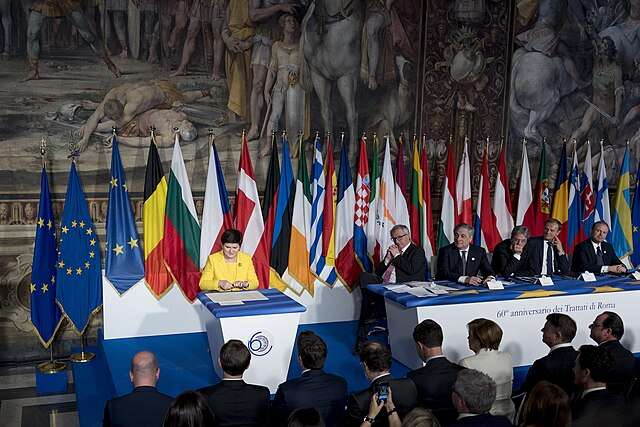
EU Defence Commissioner Andrius Kubilius has suggested the idea of forming a “Standing military force” of 100,000 troops to defend Europe’s borders from external threats. While he did not delve into the logistical details of his proposal, the message was clear – Europe can no longer rely on the US for its external security. An emboldened, irredentist Russia moving closer to the borders of the EU, alongside Trump’s renewed calls to occupy Greenland, show that world powers are questioning the capability and willingness of European nations to defend each other in the face of armed threats to their sovereignty. These challenges expose a fundamental vulnerability in European defence strategy – the lack of an autonomous military framework capable of defending its own interests independently.
The current model of allowing NATO to take the predominant role in Europe’s security may have been sufficient in the past. But an increasingly unpredictable US administration is making European leaders take the idea of an independent European defence strategy more seriously. The EU’s 2025 SAFE programme was an initial step toward increasing Europe’s defence independence, providing €150 billion in competitive, long maturity loans to member states to invest in defence capabilities, with a focus on promoting domestic European defence industries. Now, figures in the EU such as Kubilius appear to be seriously considering the idea of a military alliance of European states in some form.
While The Treaty of Lisbon contains a mutual assistance clause for EU member states (Article 42(7)), it creates no standing permanent military structure with appointed joint forces. NATO remains the primary framework, and thus the EU has no credible, autonomous enforcement capability to defend the interests of its member states without it. The EU does possess a military command body in the form of the Military Planning and Conduct Capability (MPCC), but its focus is on training, advising and building the military capacity of member states. Unlike NATO, it lacks the authority to conduct robust collective defence and credibly deter hostile actors.
The creation of such an alliance could entail reform or overhaul of the MPCC into a body that is not limited to non-executive action. Instead, it could become the seat of a permanent European Joint Headquarters, with pre-committed national forces under a unified command and integrated logistics, which could exist alongside NATO. This would have the benefit of aligning with the growing desire of the US administration to take a less involved role in Europe’s defence, as well as reducing Europe’s reliance on US assets and increasing Europe’s deterrent capabilities.
Collectively, Europe spends more on defence, has greater manpower and possesses more advanced weapons systems than Russia. Its weak point is its fragmentation – hostile states that do not predict an organised, collective response to military action may challenge the sovereignty of one European country, but will be less emboldened to engage a combined force of all 27 member states, with or without the US. In a speech in Stockholm, Kubilius asked the room: “Would the United States be militarily stronger if they would have 50 armies on the States level instead of a single federal army … Fifty state defence policies and defense budgets on the states level, instead of a single federal defense policy and budget?”.
If such an alliance were created, EU leaders will have to decide whether to limit inclusion to member states, or widen its scope to external states as a matter of pragmatic necessity. The UK, one of the strongest military powers in Europe and a member of NATO, would be of great value to the alliance and has already signed a Security & Defence Partnership with the EU in 2025. If non-EU states are included, the alliance may have to be formed independently of the EU and its institutions for the decisions of its command to be binding on all members. Traditionally Eurosceptic leaders such as Hungary’s Viktor Orbán would likely be resistant to the idea, but increasingly, attitudes towards closer military alignment appear to be changing.
This alliance would not need to replace the military forces of member states or diminish their sovereignty. Instead, these forces could operate in tandem with the alliance as they do in NATO, and strengthen the collective sovereignty of Europe from external threats.
To a certain extent, European leaders are already comfortable with the idea of collective defence. It’s embedded into EU law through the Lisbon Treaty, practised regularly through NATO and reinforced by the shared response to Russia’s invasion of Ukraine. Europe’s defence strategy must now reflect the new reality that the US can no longer be relied upon to defend it. The Trump administration has already begun reducing US troop numbers in Europe’s Eastern flank and is now openly threatening a takeover of Greenland, a territory of Denmark.
If such a scenario were to occur, Denmark’s NATO membership would do little to prevent or deter military action. Its purpose is for collective defence against external threats, and decisions are taken on the basis of consensus, which would limit any kind of collective NATO response to come to Denmark’s defence. While such a move may in theory invoke the mutual defence clause contained in the Lisbon Treaty, the Treaty also states that it “shall not prejudice the specific character of the security and defence policy of certain Member States”, meaning NATO procedures are designed to take precedence.
That is not to say that this scenario will occur or even that it is likely, but it exposes a key vulnerability in Europe’s defence strategy. Legal obligations alone cannot create credible collective defence. If the political will can be found, Kubilius argues, a comprehensive European alliance could make all of its members stronger, safer and more independent.
Leave a Reply