
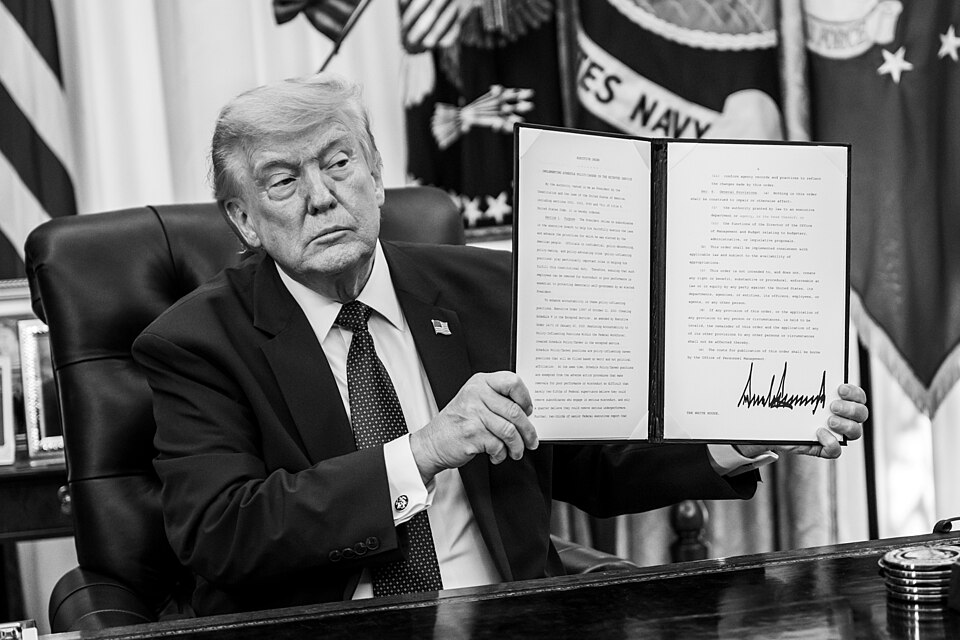
The Pentagon’s $9.7 billion Dell contract is not, at its core, a story about corruption. It is a story about structural transformation—about how the ethical firewall separating public office from private wealth in the United States has been quietly dismantled, not by statute but by normalization. When a sitting president can endorse a company by name, hold its stock, and watch a government agency award it a multi-billion-dollar contract while facing no legal sanction whatsoever, the question confronting democratic theory is not whether a crime was committed but whether the architecture of self-governance can endure the weight now placed upon it.
In May 2026, the Pentagon awarded Dell Technologies a $9.7 billion contract to consolidate Microsoft software licensing across the United States military, the intelligence community, and the Coast Guard. Dell Federal Systems has supplied the American government for decades. What transformed a routine procurement into a national debate was a sequence of events that preceded the announcement by four months.
Financial disclosure forms reveal the following: on 10 February 2026, investment accounts associated with President Donald Trump acquired Dell Technologies stock valued between $1 million and $5 million. Nine days later, at a rally in Georgia, the President urged supporters to “go out and buy a Dell computer.” Three additional Dell stock purchases followed in March. On 8 May, Trump again praised Dell at a White House event, personally thanking Michael and Susan Dell by name. Three weeks later, the Pentagon contract was announced. Dell shares had risen approximately 138 percent from their early-March baseline.
The contextual architecture thickens further: in December 2025, Michael Dell pledged $6.25 billion to fund the administration’s Trump Accounts programme for children. Dell sits on the President’s Council of Advisors on Science and Technology. The Trump Organization states that independent third-party institutions manage investment accounts without presidential direction.
The real significance lies not in whether laws were broken. None were. It lies in what the episode reveals about the changing relationship between political authority and private wealth in contemporary America—and what that change means for democratic governance.
Why the Dell Contract Matters
To assess the episode fairly, the facts must be stated without embellishment. The $9.7 billion contract pools technology budgets under a single Navy-managed procurement vehicle, replacing a patchwork of service-specific contracts at higher unit cost. Pentagon officials projected annual savings of approximately $422 million. The contract followed a competitive process assessing vendors on merit and pricing against GSA schedules.
Greg Williams, Director of the Center for Defence Information at the Project on Government Oversight, acknowledged the contract “does not constitute an ethics violation under the current rules.” Margaret Dylus-Yukins, Senior Legal Counsel at the Campaign Legal Center and a former Office of Government Ethics attorney, confirmed no statutory violation but described the episode as evidence of “the limitations of the current ethics rules and the need for widespread ethics reform.”
Yet legality and legitimacy are not synonymous. The question the Dell affair forces upon democratic attention is not whether a crime was committed, but whether any institutional mechanism exists to reliably prevent such convergences—and whether the answer is now clearly: no.
America’s Historical Ethical Tradition
For much of the post-war era, American presidents voluntarily adopted ethical standards more demanding than the law required. The tradition rested on a principle embedded in conflict-of-interest jurisprudence: that public officeholders must avoid not only corruption itself, but also its appearance.
President Carter placed his peanut farm in a blind trust without legal compulsion. Reagan divested significant holdings. Both Presidents Bush established blind trusts with independent trustees. Obama avoided individual stock ownership. Biden maintained an equally straightforward investment structure. Each made these choices from a shared understanding that the presidency carries a moral obligation to insulate public decision-making from private enrichment.
For decades, American democracy relied on norms rather than laws to govern the financial conduct of its chief executive. The presidency was expected not merely to avoid corruption but to avoid its very appearance. That expectation is now functionally inoperative.
This norm performed a critical function: when citizens and markets trust that presidential endorsements reflect genuine policy rather than portfolio management, the institution of government retains its legitimacy as a coordinator of collective action. Once that assurance erodes—even through technically lawful behaviour—the entire edifice of public trust becomes unstable.
The Ethics Gap in the US Constitution
Many assume the President is subject to the same conflict-of-interest statutes governing ordinary federal officials. This assumption is incorrect. The primary statute, 18 U.S.C. § 208, prohibits executive branch officials from participating in matters in which they hold a personal financial interest. It explicitly exempts the President and Vice President. The Department of Justice concluded in 1974 that the statute was never intended to reach the President; Congress codified the exemption expressly in 1989.
The rationale was pragmatic: the breadth of presidential responsibilities makes recusal from every financially relevant matter structurally impossible. The system therefore substitutes an unenforceable expectation of virtue for a legally enforceable requirement of separation. Disclosure requirements provide sunlight—the capacity to observe what is happening—but visibility without enforceability is only a partial safeguard. A system that can illuminate but not adjudicate has traded the rule of law for the theatre of transparency.
The American system assumes presidential self-restraint rather than legally
enforceable separation between power and profit. This is not a design flaw that was overlooked. It is a design choice that has outlived the norms that once gave it meaning.
This gap extends beyond Dell. Trump’s disclosure revealed purchases of Microsoft and Amazon stock before the Pentagon announced major contracts with both firms, and participation in cryptocurrency ventures whose valuations are directly sensitive to regulatory decisions the President has authority to influence. The architecture of self-governance was built for a president who stood above the market. It provides no remedy for a presidency that has entered it.
From Public Service to Personal Portfolio
The Dell episode is most accurately understood as a legible instance of a structural transformation in the political economy of democratic leadership. The traditional model ran in a single direction: money generated political influence. Private capital flowed toward public authority through donations and lobbying. The ethical architecture of democratic governance was designed to regulate this flow.
That model has been reversed. Political power now generates private wealth with a directness and speed that has no historical precedent in the American experience. Presidential endorsements move market valuations. A single presidential statement can shift a company’s share price by double-digit percentages within hours—producing effects once associated with Federal Reserve communications. Cryptocurrency ventures attract institutional capital on the basis of anticipated regulatory forbearance. Family businesses benefit from proximity to government contracting decisions.
Modern political power increasingly behaves like a market-moving asset. A
presidential endorsement can now influence valuations in ways once associated with central bank announcements. The market has priced in the presidency. Democratic theory has not caught up.
The Dell case illustrates with precision the structural conditions under which such connections become possible, plausible, and ultimately normalised. The presidency has become, in practice, a platform from which the holder can influence the very markets in which he is invested—without the legal constraints that prohibit any other executive branch official from doing the same.
International Comparisons
The United States’ permissiveness in this domain becomes striking in comparative perspective. France requires strict financial disclosure from all senior officials under legislation enforced by the independent Haute Autorité pour la Transparence de la Vie Publique, which embeds the principle of impartiality as a legally enforceable standard. Germany’s parliamentary architecture distributes executive authority across a coalition cabinet subject to continuous Bundestag oversight and independent audit by the Federal Court of Audit—a structure that makes individual-level self-dealing harder to sustain undetected. Singapore’s Corrupt Practices Investigation Bureau applies legally binding requirements to all public officials without exception. Even the People’s Republic of China, operating under an entirely different political system, maintains formal institutional mechanisms constraining official financial conduct with a rigour that has no American equivalent.
Why does the world’s leading democracy rely on weaker formal ethical constraints on its chief executive than many of its peers? The answer lies in an assumption embedded in American constitutional design: that republican virtue would substitute for republican law. That assumption has outlived the conditions that made it workable.
The Strategic Consequences
The implications extend far beyond domestic controversy. For a nation whose foreign policy rests substantially on the perceived legitimacy of its institutions—whose soft power depends on others believing in the integrity of the American model—the erosion of executive branch ethics carries strategic costs that are only beginning to be calculated.
At the level of domestic governance, the normalisation of the presidency-as-asset-class model creates systematic market distortions. Investors who track presidential endorsements and disclosures gain informational advantages that translate into returns uncorrelated with productive economic activity. Government contracting decisions occurring against a backdrop of presidential investment positions invite permanent suspicion regardless of actual merit, degrading the coordination function of democratic institutions.
The strategic cost extends further. American foreign policy has long derived leverage from the perceived legitimacy of its institutions. When American officials raise concerns about corruption in partner governments, the authority of those representations depends on the credibility of the American model itself. The Dell controversy has been cited by strategic competitors as evidence that American lectures on governance represent projection rather than principle. Great powers depend not only on military strength but also on institutional legitimacy. Every presidential stock purchase and endorsement-to-contract sequence erodes the credibility upon which American global leadership depends.
Conclusion
Return, finally, to Dell. The company is legitimate. The contract was competitively awarded and will deliver substantial savings. Michael Dell’s philanthropy is genuine. None of the individual elements of this story, considered in isolation, constitutes a scandal.
The concern is systemic. It lies not in any particular transaction but in the structural conditions that make such transactions simultaneously possible, legal, and generative of justified public suspicion. When a president can hold equity in a company, endorse it publicly on multiple occasions, and watch a federal agency award it $9.7 billion—all within a framework that classifies this sequence as permissible—democratic theory must confront whether the institutional architecture designed to prevent self-dealing retains any meaningful function.
The Dell affair is less a story about Donald Trump than about the United States—about the gap between the ethical infrastructure of a twentieth-century republic and the financial realities of twenty-first-century executive power. Closing that gap requires legislative action: statutory extension of conflict-of-interest requirements to the President and Vice President, mandatory blind trust arrangements with genuinely independent trustees, and enforcement mechanisms that do not depend on voluntary norm compliance that has already proved optional.
Democracies survive not merely through laws but through confidence that public power serves public purposes. When that confidence erodes, every contract, every investment, and every presidential endorsement becomes a source of suspicion. The Dell controversy raises a question far larger than one company or one president: can the United States preserve the ethical firewall between political authority and private wealth, or has the presidency itself become a tradable asset in the modern political marketplace?
Vikas Bhardwaj is a scholar of international political economy, holding a Ph.D. and M.Phil. from the Centre for Russian and Central Asian Studies, School of International Studies, Jawaharlal Nehru University (JNU), New Delhi. His work focuses on economic statecraft, sanctions, energy geopolitics, and global economic governance. He has worked as a researcher with numerous institutions, including the Indian Institute of Public Administration (IIPA), contributing to multiple policy evaluation projects commissioned by the
Government of India Ministries. Bhardwaj holds nine academic degrees and has published in international peer-reviewed journals on the Russian economy, geopolitical conflict, and shifting global power dynamics.
Leave a Reply