
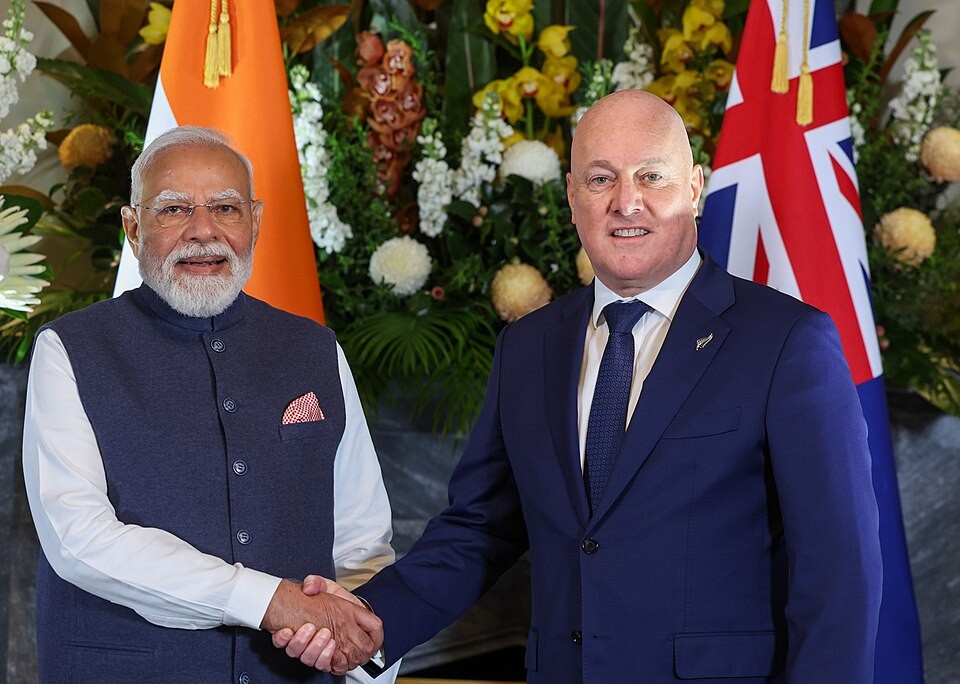
India and New Zealand’s free trade agreement is set to come into force next month. The two countries signed it on 27 April 2026. The deal is the latest sign that the relationship has grown well beyond just trade.
Prime Minister Narendra Modi’s visit to New Zealand on 10–11 July was the first by an Indian leader in forty years. During the trip, Modi and New Zealand’s Christopher Luxon upgraded ties to a Strategic Partnership and backed a “Roadmap to 2030” covering diplomacy, defence, trade, technology, education and regional security.
Indian outlet Firstpost described the visit as the start of “a new era.” In the Indo-Pacific, security and economics are increasingly linked. Both countries care about supply-chain resilience, maritime stability, tech cooperation and critical infrastructure. For India and New Zealand, the closer relationship is less about trade numbers and more about two democracies that want a stable, open, rules-based region.
Trade agreement becomes strategic bedrock
The FTA provides the economic foundation for this new phase. New Zealand offers 100% duty-free access to all Indian exports. India has liberalized duties on about 70% of tariff lines for New Zealand exports. The agreement also establishes Centers of Excellence for agriculture. Together, these measures should deepen economic cooperation between the two countries.
Both governments have set an ambitious target: doubling trade in goods and services to seven billion New Zealand dollars (about $4.1 billion) by 2030. Tariff cuts alone will not get them there. Reaching that goal will require better connectivity, stronger business links and greater private-sector participation.
The Roadmap to 2030 creates no financial obligations. Its value lies elsewhere — in building mechanisms for sustained cooperation. The two countries have committed to regular consultations between leaders, ministers and senior officials. That commitment keeps the Strategic Partnership a living process rather than a one-time declaration.
Security cooperation grows in a changing Indo-Pacific
The biggest shift in India–New Zealand relations may be happening in security. A changing geopolitical landscape has pulled the two countries closer. Both want a free, open and inclusive Indo-Pacific grounded in the rules-based international order and freedom of navigation.
The Roadmap’s defense component reflects that reality. Building on the 2025 Memorandum of Understanding on Defense Cooperation, India and New Zealand agreed to expand military exchanges, joint exercises, maritime cooperation and exchanges between their armed forces.
Maritime security carries particular weight. Both countries depend on secure sea lanes for trade and energy. Cooperation on naval exercises, hydrography, logistics support and maritime dialogue reflects a shared belief: Regional stability depends on keeping the maritime environment open.
Trade and security cannot be separated
Modi’s visit also produced a joint working group on counterterrorism. This drew less attention than the trade and defense announcements. But it explains why New Zealand matters to Delhi.
Dhruva Jaishankar, executive director of the Observer Research Foundation America, told RNZ that transnational crime, terrorism and narcotics problems increasingly cross borders. For India, building government-to-government mechanisms with countries like New Zealand offers a way to catch problems before they become crises.
Jaishankar pushed back on a common framing — that observers should read the FTA mainly through a geopolitical lens rather than as a genuine trade agreement. The economic and strategic dimensions, he argued, cannot be fully separated. “In this day and age, we can’t completely separate economics and strategy,” he said.
That view fits both countries’ current position. The FTA and the Strategic Partnership complement each other; they are not separate developments.
Jaishankar placed this within a longer arc of Indian foreign policy. It runs from the 1990s “look east” policy, focused mainly on economic engagement, to today’s more security-conscious approach. On New Zealand specifically, he pointed to opportunities for Indian exports in petroleum products, IT and AI-related services, and auto parts and electronics. He also flagged potential gains in investment and education.
People-to-people ties matter too. New Zealand hosts a large Indian diaspora that contributes to its economy, culture and social fabric. New Zealand’s government has called this diaspora a “vital living bridge” that strengthens cultural, commercial, educational and social ties between the two countries.
The relationship outgrows trade
Firstpost noted that New Zealand increasingly sees India as a global economic power and as a partner for diversifying its own economic relationships.
The India–New Zealand relationship no longer rests on trade alone. The Strategic Partnership shows that economic security and strategic security have become interconnected. Economic cooperation now sits alongside defense coordination, technological collaboration, counterterrorism cooperation and people-to-people ties.
The FTA opened the door to closer India–New Zealand relations. Its entry into force next month turns that opening into daily reality. The Strategic Partnership, meanwhile, is turning the relationship into a full political, economic and security partnership.
Photo Credit: Prime Minister’s Office (PIB), via Wikimedia Commons / Licensed under GODL-India.

Leave a Reply